



When Stock Soft Armor Will Not Fit Your Body: How to Know and What to Do About It
Most soft armor fits most people. For the people it does not fit, the fix is not a different stock size. The common body types where stock armor fails, how to recognize it, and when custom panels are actually the right answer.
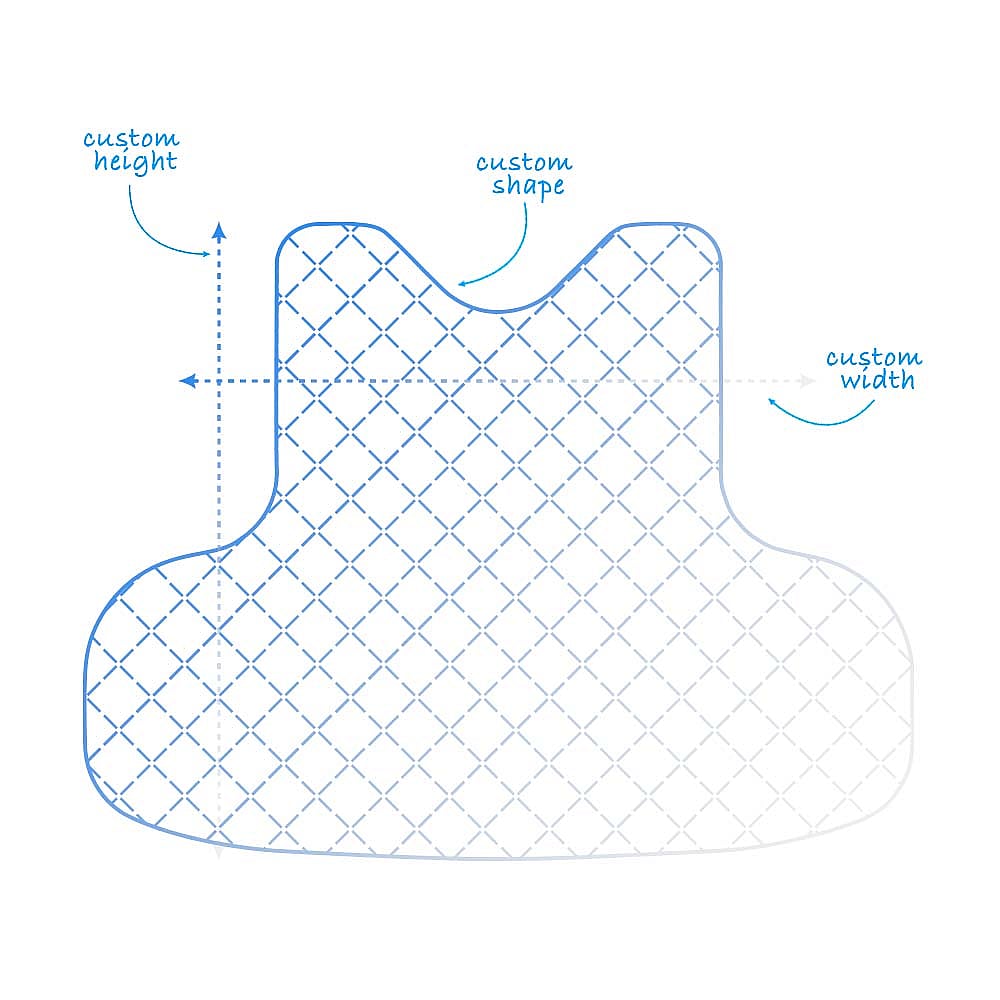
Most soft armor fits most people. That is the whole point of stock sizes. A Small, Medium, Large, and Extra Large covering the 5th through 95th percentile of adult body dimensions handles the overwhelming majority of buyers. If you are in that range, stock armor from any reputable manufacturer should work for you out of the box.
But stock armor is built around an assumed body curve. Broad shoulders, narrow waist, average torso length, standard chest depth. The curve covers a lot of people, but not everyone. If you are outside that curve in meaningful ways, you have probably already felt it. The armor does not sit where it should. The panel edges bite. The coverage gaps are bigger than the manufacturer’s spec implies. Adjusting the carrier helps but does not fix the underlying problem.
This article is for the people stock armor does not serve. If you have struggled with fit for reasons that no amount of cummerbund adjustment seems to solve, the issue is probably the armor itself, not your technique. Here is how to recognize the patterns and what to do about it.
The Bodies Stock Armor Is Built For
Most soft armor sizing charts are built around assumed male body dimensions in the 5th to 95th percentile. An average adult male is roughly 5’9″, 195 lbs, with a 42-44 inch chest, a 17-18 inch torso, and proportions that follow a standard male body curve.
Stock sizing stretches that assumed body a few inches in each direction. A Small might fit a 5’4″ 160-pound man with a 38-inch chest. An Extra Large might fit a 6’3″ 240-pound man with a 48-inch chest. Every size between is a stretch toward or away from the baseline average.
The result is armor that fits most adult males reasonably well. Not perfectly, but well enough for stock sizing to be a workable default. That is why most soft armor companies invest in stock sizes and treat custom as an exception.
The people stock sizing does not fit well are the people whose proportions fall outside that assumed curve. And there are more of them than the industry typically acknowledges.
Common Patterns Where Stock Does Not Work
Very Tall or Very Short Torsos
Torso length is measured from the suprasternal notch (the soft dip between your collarbones) down to your navel. Most adult males land between 16 and 19 inches. Stock armor is sized assuming that range.
If your torso is 20-22 inches (common for taller men), stock armor sized to fit your chest circumference will leave meaningful gaps at the top of the panel and at the bottom. You will either get a panel that covers your vitals correctly but is too narrow for your chest, or a panel that matches your chest width but sits too low to actually protect what it needs to protect.
If your torso is 14-15 inches (common for shorter men, some women, or people with compressed torsos relative to their overall height), standard armor panels can extend below the natural waistline, binding into the hips or obstructing a duty belt.
Broad Chest, Narrow Waist
Common in trained lifters, swimmers, and specific body types. A 48-inch chest with a 34-inch waist is a significant taper that stock armor does not accommodate. The chest panel sized to fit the upper torso will gap at the waist. The cummerbund sized to fit the waist will not reach around the chest.
You end up with a choice between armor that fits the chest and floats at the waist, or armor that fits the waist and pinches the chest. Neither protects as designed.
Female Bodies
Most soft armor is not designed for female body geometry, full stop. The differences are not subtle: narrower shoulders, shorter torso, different chest profile, wider hip-to-waist taper, and different weight distribution. Stock “unisex” armor sized to fit a woman’s chest circumference typically sits wrong in multiple ways simultaneously.
A few manufacturers now build female-specific stock sizes. These are an improvement over unisex, but they are still built around assumed averages, and individual variation within the female population is just as wide as within the male population. A female-specific stock size that fits one woman poorly does not become a good fit for another woman with different proportions.
For women who do not fit stock female sizing, custom is often the only path to armor that actually fits.
Very Large or Very Small Overall Builds
Standard sizing runs from roughly Small to Extra Large (sometimes XXL). Outside that range, options get sparse.
A very large wearer (6’5″, 280+ lbs) may find that even XXL stock panels do not provide adequate coverage for their actual torso dimensions. The panels fit the available size range but leave more exposed skin than the armor’s rated coverage suggests.
A very small wearer (5’1″, 110 lbs) may find that Small stock panels are still too large, with edges that protrude past the shoulders or sides and obstruct movement. For very small builds, custom-sized panels are often the only option that does not turn the armor into a wearable obstacle.
Non-Standard Proportions
Some people fall inside the overall size range but have proportions that do not match the assumed body curve. A shorter person with a broader chest than their height suggests. A taller person with a narrower frame. A person recovering from injury or surgery whose body asymmetry affects fit. A person with a specific medical condition that affects body shape.
Stock armor does not accommodate these variations. The sizing chart assumes standard proportions within each size band. If your proportions are unusual relative to your overall size, stock armor will fit poorly regardless of which size you choose.
How to Know Your Stock Armor Is Not Working
Some signs are obvious. Others are easy to miss because you have adjusted around them without realizing it.
Obvious Signs
- Panel edges protruding past your shoulders or biting into your sides when you move
- Visible coverage gaps between the edge of the panel and your body, especially at the sides of the torso
- Panel sitting above or below the correct vertical position and not stayable in the correct place regardless of adjustment
- Soft armor inserts that do not lie flat inside the carrier’s soft armor pocket
- Soft armor that bunches or folds during wear
Less Obvious Signs
- You have bought multiple sizes trying to find one that fits and still are not satisfied
- You have modified your carrier extensively to work around soft armor that does not fit the pocket correctly
- You regularly feel the armor shifting or moving during normal activity
- Chafing, pressure points, or hot spots at the same locations repeatedly, suggesting the armor is sitting wrong rather than just needing break-in
- You have stopped wearing your soft armor as often as you should because the fit is uncomfortable
That last point matters more than most buyers realize. Armor you do not wear does not protect you. If stock armor fits poorly enough that you leave it in the closet more than you put it on, you have effectively paid for no protection at all. Custom armor that fits well and gets worn consistently is more useful than premium stock armor that sits unused.
What Custom Actually Solves
Custom soft armor is built to your body’s actual measurements, not to a standard size approximation. The process addresses three main problems that stock cannot.
Correct coverage. The panel is sized to cover the organs you need protected, not the organs that a standard body curve assumes you have in standard positions. Your suprasternal notch is where it is. Your navel is where it is. The panel is cut to span that distance on your body, with correct width for your chest circumference.
No gaps. Side-torso coverage is sized to fit the specific carrier you use, not a generic assumption. The cummerbund soft armor matches your body’s curve, not a standard one. The result is armor that covers what it is supposed to cover without exposed zones at the edges.
No fit compromises. The panel sits correctly on your body, not where the nearest stock size forces it. Break-in is faster because the fit starts correctly instead of needing to be adjusted around. Wear is more comfortable, which means more consistent protection because you actually wear it.
How Our Custom Program Works
Custom soft armor sounds expensive and exotic, but it is actually a pretty direct process once you know what is involved.
You choose your ballistic material first. We build panels using our in-house MASS (Kevlar-based) and MASS Air (Honeywell-based) soft armor, both tested to NIJ 0101.06 Level IIIA. For customers who need formally certified panels, we also source and build with NIJ-certified Onyx and Slate material. Both options are American-made.
You provide measurements. We give you a measurement guide for chest circumference, torso length, and any other dimensions relevant to your specific carrier and coverage needs. If you have unusual proportions, we will ask follow-up questions to make sure the cut accommodates them.
We cut, sew, seal, and finish the panels in Knoxville. Turnaround is typically 2-4 weeks from order to shipment, depending on production queue. The panels are built to the same quality standards as our stock armor, with moisture-sealed covers and full NIJ 0101.06 testing protocols on the underlying ballistic material.
The full details are on our Custom Soft Armor page, including pricing, the measurement process, and the material choices.
When Custom Is Not the Right Answer
Honesty matters. Custom is not always the right solution.
If your body falls inside the standard size range and you have not actually tested a stock armor setup with proper fitting and break-in, try stock first. Custom costs more and takes longer than buying off the shelf. If stock works for your body, there is no reason to pay for custom.
If your fit problems are actually carrier problems, not armor problems, a different carrier might solve what you think is an armor sizing issue. We can help diagnose this. Sometimes a better-fitting carrier with the same stock soft armor resolves the problem without any custom work.
If your threat profile suggests you should be wearing hard plates anyway, the soft armor fit question may be secondary. A Level III or Level IV hard plate setup with a reasonable soft armor backer handles most threats regardless of exact soft armor fit. Fit still matters, but it matters less if the primary protection is the hard plate.
Next Steps If Stock Is Not Working
If you have read this article and recognize your own experience in it, here is what to do.
First, check whether your current fit problems are armor problems or carrier problems. Try the armor in a different carrier if possible. If it fits better in the different carrier, the carrier was the issue. If it fits the same or worse, the armor itself does not match your body.
Second, measure yourself carefully. Chest circumference at the widest point under your arms. Torso length from suprasternal notch to navel. If you can, have someone else measure you. Self-measurement is prone to error, especially on the torso length.
Third, contact us. Text 865.859.9850 or email support@midwestarmor.com. Describe your current armor, your fit problems, and your measurements. We will tell you honestly whether custom is the right path or whether a different stock size or different carrier would solve the problem without custom work.
If custom is the right path, we walk you through the process from there. Full details on the program and the build process are on our Custom Soft Armor page.
For the broader picture on armor selection, threat levels, and buyer decisions, our Body Armor Guide covers the full landscape.
Ops-Core FAST SF Gen II Guide: Sizing, Weight, Protection and Setup
Ops-Core makes the FAST helmet, the high cut design most of the market has copied since. Ops-Core is part of Gentex Corporation, and its helmets are…
Ops-Core FAST SF Gen II vs PGD ARCH GEN3: Which High Cut Helmet to Buy
We carry two high cut ballistic helmets: the Ops-Core FAST SF Gen II and the PGD ARCH GEN3. Both are rated NIJ Level IIIA, both have…
Custom Soft Armor: How to Get Inserts That Actually Fit Your Carrier
Most soft armor doesn't fit the carrier you actually own. Here's how our Custom Soft Armor program solves the fit problem and when to choose custom…